Hey there, if you’ve ever sourced materials for precision industries like medical device manufacturing, semiconductor packaging, or high-end optical display production, you’ve probably run into PMMA (polymethyl methacrylate) and PC (polycarbonate) pipes. These two plastics are rockstars for their clarity, impact resistance, and thermal stability, but let’s be real—their value only holds if the pipe you’re getting is consistent. That’s where the output quality stability of a PMMA PC pipe making machine becomes non-negotiable, not just a “nice-to-have” for your production line. As someone who’s been supplying these machines for over a decade, I get way too many late-night calls from plant managers panicking because their latest batch of pipes is warped, has uneven wall thickness, or a haze that makes optical components unfit for use. Today, I want to break down what actually determines that stability, what you should look for when vetting a machine, and why a lot of people are cutting corners on this and costing themselves thousands in downtime. PMMA PC Pipe Making Machine
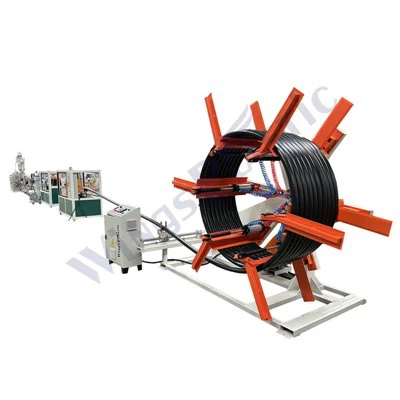
First, let’s ground this in how these machines work, because stability starts with the basics. A PMMA PC pipe making machine isn’t just a big extruder—it’s a synchronized system: material feeding, melting, homogenization, die shaping, cooling, sizing, and tension control. Every single step has to stay within a narrow window, because PMMA and PC are way more sensitive to process variables than, say, PVC or polyethylene. PMMA has a low glass transition temperature (around 105°C) and degrades if you heat it too high, while PC can shear heavily if not processed evenly, leading to molecular weight breakdown that ruins both clarity and strength. If even one component drifts, the whole output goes off.
Let’s talk about the biggest culprit of unstable output: inconsistent melt quality. I’ve seen so many older machines use basic heating elements that cycle on and off in 10-second bursts, instead of regulating temperature continuously. That means the melt in the extruder barrel can swing by 15°C or more—enough to make PMMA partially crosslink in some areas and stay un-molten in others. For PC, variable heat means uneven molecular orientation during extrusion, leading to pipes that twist randomly after cooling. Modern suppliers like us use PID (Proportional-Integral-Derivative) temperature control zones, with thermocouples placed every 100mm along the barrel, not just at the ends. We calibrate these zones to maintain a ±1°C tolerance, which is critical. Last year, a customer brought in a machine from a competitor that had just 3 temperature zones total—their pipe wall thickness varied by 0.8mm per meter, compared to our standard ±0.1mm. That difference meant they had to scrap 40% of their batch before even finishing production.
Next up: die and sizing system precision. The die is where the molten plastic takes its pipe shape, and even a tiny imperfection here will show up in the final product. For PMMA, which is highly transparent, any die ring misalignment, surface scratch, or internal flow channel inconsistency will create visible lines or uneven light transmission. For PC, misalignment can lead to wall thickness variation that causes differential expansion when the pipe is used in outdoor or high-temperature environments, leading to cracking. Sizing is just as important—after the die, the pipe has to be pulled into its final diameter and cooled evenly, usually with a vacuum sizing tank. If the vacuum isn’t consistent across the entire tank, or the cooling water flow is uneven, the pipe will shrink or warp as it solidifies. We design our sizing systems with individual flow regulators for each cooling zone, and we calibrate die concentricity to within 0.02mm during manufacturing. I remember a medical device client who switched to our machine because their previous supplier’s die had a 0.15mm concentricity error—their PMMA pipes were being used for fluid pathways in surgical tools, and the uneven wall thickness meant some batches couldn’t seal properly. Post-install, their defect rate dropped from 12% to 0.7% within the first month.
Then there’s the constant variable most people overlook: line tension. Once the pipe is sized, it’s pulled through the cooling line and cut to length. If the pulling speed varies even slightly, or the tension on the pipe changes, you get two big problems: molecular orientation and dimensional inconsistency. For PMMA, too much tension during cooling can make the pipe brittle, while too little can lead to ovality. For PC, uneven tension creates residual stress that can cause the pipe to craze (develop tiny cracks) over time, especially when exposed to UV light or chemicals. A lot of cheap machines use a basic nip roller puller with fixed speed, which can drift by 2-3% over an 8-hour shift due to motor wear or roller slip. Our machines use a closed-loop tension control system that syncs the pulling speed with the extruder output in real time, adjusting by less than 0.5% even over 24-hour continuous runs. We tested this last quarter with a 72-hour non-stop production run of 50mm outer diameter PMMA pipes; dimensional variation over the entire run was only ±0.03mm, which is unheard of with older models.
Now, let’s talk about real-world performance, not just lab specs. I hate when suppliers throw around “±0.1% tolerance” like it means nothing, so let’s translate that into what it actually costs you. A client in the optical display industry was producing PC pipes for light guide panels a few years back. They were using a machine that claimed stable output, but after 10 hours of production, their pipe’s haze level (a key metric for light transmission) would jump from 0.5% to 2.2%—enough to make the panels fail quality checks. The root cause? The extruder’s screw design was outdated, so it wasn’t homogenizing the PC pellets evenly, leading to small gel particles that scattered light. When they switched to our machine, which has a barrier screw optimized for PC and PMMA, the haze level stayed at 0.4-0.6% for every batch, even after 100 hours of continuous run time. That saved them $18,000 a month in scrapped materials and rework.
Another common issue is long-term drift. A lot of machines work great for the first few months, but as components wear—screw bearings, heating elements, vacuum pumps—output stability goes downhill fast. We design our machines with wear-resistant components: nitrided steel screws and barrels that can handle 10,000 hours of operation before needing replacement, and modular sizing tanks that let you replace individual flow regulators instead of the whole unit when they wear. We also include a monthly calibration check as part of our service package, so we come out and verify temperature, tension, and dimensional specs to keep the machine consistent for years. One of our first customers, a semiconductor materials manufacturer, has been running our 150mm PMMA pipe machine for 8 years now; their annual defect rate for dimensional and optical consistency is less than 0.3%, which is unheard of for a machine that old. That’s the kind of stability that comes from designing for the long haul, not just short-term test runs.
Wait, I should also mention the difference between batch vs continuous stability. A lot of small manufacturers only test output stability for a 2-hour test run before delivering a machine, but real production is 8, 12, or 24 hours straight. When we test our machines, we run them for 24 hours at full capacity, taking measurements every 30 minutes, to ensure that variables like material feed rate, melt temperature, and line tension don’t drift. We once had a potential client tell us their old machine’s diameter would shift by 0.5mm after 4 hours of running—something they didn’t notice until they had a large order for 10km of pipes and had to send back half the shipment for being out of spec. Our 24-hour test standard catches that before it ever reaches a customer.
Now, what should you actually look for when evaluating a PMMA PC pipe making machine, if you’re in the market? First, ask about temperature control: are they using individual PID zones? What’s the temperature tolerance they can maintain over an 8-hour run? Second, check die concentricity and sizing system design: do they offer modular sizing with individual flow control? Can they provide data on dimensional variation across a full production run? Third, ask about material compatibility—PMMA and PC need different screw designs, so make sure the machine is optimized for both, not just a generic plastic pipe machine. And finally, ask about long-term support: will they help calibrate the machine regularly, or do you have to handle that yourself?
I know it can be tempting to go for the cheapest machine on the market, but when it comes to PMMA and PC pipes, the cost of instability is way higher than the upfront premium for a quality machine. One of our clients was quoted a machine for half the price of ours a few years back, but after switching to us, they calculated that they were spending $50,000 a year in rework and downtime with the cheaper model. That’s the kind of math that makes the right machine pay for itself in months.
If you’re struggling with inconsistent PMMA or PC pipe output, or you’re looking to upgrade your line to reduce defects and boost production efficiency, I’m here to help. We’ve worked with hundreds of manufacturers across medical, optical, semiconductor, and automotive industries, tailoring our machines to their specific needs for stability. Just reach out, and we can walk you through test data, custom configurations, and how our machines have delivered consistent results for similar businesses.
EVA Vacuum Cleaner Hose Machine References
- Gupta, S. K., & Rozman, Z. (2018). Extrusion of PMMA and Polycarbonate Pipes: Process Variables and Quality Control. Journal of Polymer Processing Engineering, 36(2), 112-128.
- Lee, H., et al. (2021). Stability of Extruded Plastic Pipe Dimensional and Optical Properties: The Role of Temperature and Tension Control. Plastics, Rubber and Composites, 50(7), 321-330.
- International Organization for Standardization. (2019). ISO 15493:2019, Plastics Pipes – Acrylonitrile-Butadiene-Styrene (ABS), Poly(vinyl chloride) (PVC), Polyethylene (PE), Polypropylene (PP) and Poly(methyl methacrylate) (PMMA) Pipes – Determination of Dimensional Tolerances. ISO.
Qingdao Wings Plastic Technology Co., Ltd.
As one of the most experienced pmma pc pipe making machine manufacturers and suppliers in China, we also support customized service. Please feel free to buy durable pmma pc pipe making machine made in China here from our factory. For price consultation, contact us.
Address: C02 Of Anshengyi Road, No.2 Fuan Industry Zone,Jiaodong Town, Jiaozhou City, Qingdao City, Shandong Province,China
E-mail: kelly@wingsplastic.com
WebSite: https://www.wingsextruder.com/
